


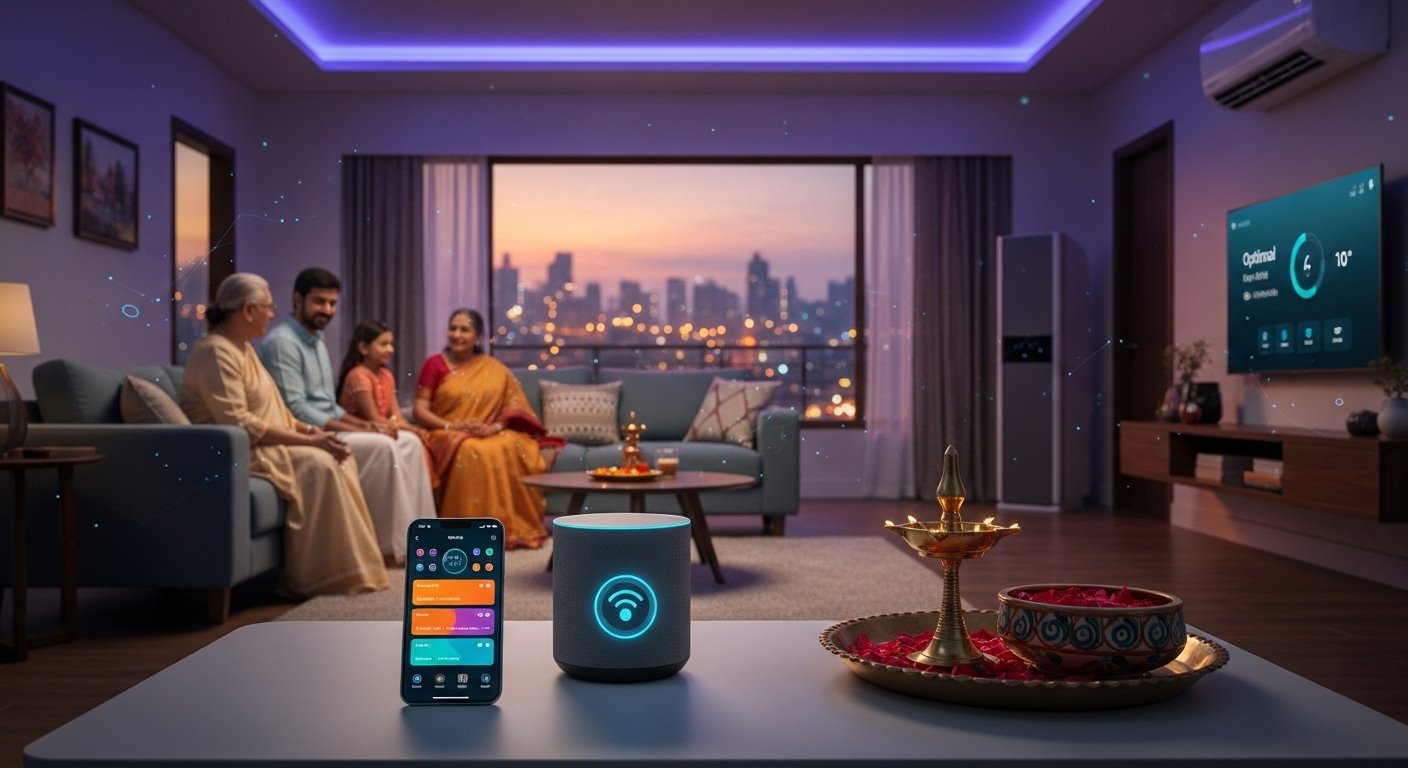
The way we look at our living spaces is changing fast. Artificial intelligence is now the brain of the modern Indian household. It acts like an invisible conductor that keeps everything running smoothly. You do not have to worry about the small stuff anymore. Your home handles the chores while you focus on what really matters. This scene is becoming increasingly common across India as smart homes powered by AI open up new possibilities for comfort, efficiency, and security.
- The Invisible Conductor: AI works in the background to manage your lights, music, and kitchen tools without being asked.
- Evolution of Living: Smart homes have moved from being a fancy dream to a practical tool for regular people.
- The Concept of Intelligent Living: Your devices actually learn from your habits to make your life easier by predicting your needs.
- The Indian Context: Cheap internet and the digital boom are bringing this tech to homes all across the country.
Why Smart Homes Are Becoming a Reality in India
A few years ago, this tech was only for the super-rich. Now, things are totally different because prices have dropped a lot. You can find smart gadgets in local shops and online for very little money. This shift is making the dream of a high-tech home real for millions of families. India, with its booming digital growth and affordable internet, is an exciting space for smart living.
Technological and Economic Drivers
The main reason for this change is that the hardware is now very affordable. You can buy a smart bulb or a plug for less than the cost of a fancy dinner. Also, mobile data is super cheap in India thanks to companies like Jio and Airtel. This means your devices can stay connected all the time without costing a fortune.
- Affordability of Hardware: Prices for smart gadgets have fallen, making them easy for middle-class families to buy.
- Mobile Internet as the Backbone: High-speed 4G and 5G provide the constant connection that smart devices need to work.
- Urbanization and Fast-Paced Lifestyles: People in big cities need tools that save time and reduce daily stress.
Demographic and Social Shifts
Young people are leading the way in this tech revolution. Millennials and Gen Z love using new gadgets to make their lives better. They are the ones showing their parents how to use voice commands. This makes the whole family feel more comfortable with using artificial intelligence at home.
- Influence of Millennials and Gen Z: Younger generations are the biggest fans of smart tech and drive household buying.
- Inclusivity for All Ages: Voice controls make it easy for kids and grandparents to use tech without confusing apps.
- The Digital India Impact: Government programs like the Smart Cities Mission are helping build the infrastructure we need.
AI Is Changing Indian Homes Everyday
You might not notice it, but AI is quietly helping you throughout the day. It starts the moment you wake up and continues until you go to bed. It makes your home feel more alive and responsive to your needs. This is how smart homes using ai in India, opening up new possibilities for a better lifestyle.
Smart Assistants and the Heart of the Home

The kitchen is often the busiest part of any Indian home. AI assistants like Alexa and Google Home are now perfect kitchen helpers. They can find recipes, set timers for chai, and add milk to your shopping list. It is like having an extra set of hands when you are busy cooking.
- Voice-Activated Kitchens: You can control your oven or kettle just by talking to your smart speaker.
- Regional Language Support: Devices now understand Hindi and other local languages, so everyone can join in.
- Personalized Routines: Your home can automatically open curtains and start the coffee machine at sunrise.
AI-Powered Security and Safety

Security is a top priority for every family in India. AI cameras are much smarter than the old versions we used to have. They can tell the difference between a family member and a stranger. This helps prevent false alarms and keeps your home truly safe.
- Advanced Surveillance: Cameras use facial recognition to let you know exactly who is at your front door.
- Remote Monitoring: You can check on your home or pets from your smartphone while you are at work.
- Smart Locks and Access Control: Use your fingerprint or a phone app to lock and unlock your doors from anywhere.
Energy Management and Efficiency

Electricity bills can be a big headache for many households. Smart devices are here to help you save a lot of money. They turn off lights and fans when no one is in the room. This makes your home more efficient and better for the planet too.
- Intelligent Climate Control: Thermostats adjust your AC based on the weather and if you are home.
- Cost Savings for the Middle Class: Some families save up to 30% on their bills by using smart energy tools.
- Smart Meters: These devices show you exactly how much power you use so you can make better choices.
Technologies Powering the Smart Home Shift
The tech inside these gadgets is actually very complex, but it feels simple to use. Computers are now able to see, hear, and learn just like humans do. This is what makes a home “smart” instead of just automated.
The Brain Behind the Devices
Artificial intelligence uses several different tools to understand what you want. Natural Language Processing helps it understand your voice commands. Machine learning allows the device to get smarter the more you use it. It begins to predict your needs before you even realize them yourself.
- Natural Language Processing (NLP): This allows you to talk to your home in a natural, easy way.
- Computer Vision: Cameras use this to identify objects, people, and movements with high accuracy.
- Machine Learning: Devices track your patterns to learn when to turn on the geyser or lights.
Connectivity and the Ecosystem
For a smart home to work, all the devices need to talk to each other. This is called the Internet of Things, or IoT for short. When your sensors, lights, and phone are all connected, they work as one team.
- Internet of Things (IoT) Integration: This links all your gadgets together so they can be controlled from one app.
- The Role of 5G: New 5G networks make connections faster so there is no delay when you tap a button.
- Edge Computing: This tech processes data right on the device for better speed and privacy.
The Indian Advantage – A Unique Market Strategy

India is not just copying the West when it comes to smart homes. We are building our own way that fits our unique culture and needs. The focus here is on solving real problems that people face every day.
- Practical Value Over Status Symbols: Most Indians buy smart tech to save money or improve safety, not just to show off.
- Localized Innovation: Companies are making gadgets that can handle power cuts and voltage jumps common in India.
- Tier-2 and Tier-3 City Growth: Small towns are adopting this tech quickly because it is now very affordable.
Cultural Nuances and the Human Element
Technology in India always has to account for our strong family ties. Smart homes are helping bring families together rather than pulling them apart. It is about making life better for the whole household, from kids to seniors.
- Preserving Family Values: AI helps manage large households by automating boring chores so families can spend time together.
- The Generational Bridge: Kids get to bond with grandparents by showing them how to use voice-controlled lights.
- Customizing for Indian Routines: Smart homes can be set up for specific rituals, like playing bhajans in the morning.
Industry and Government Ecosystem
The growth of smart homes using ai in india opening up new possibilities is a big team effort. Both the government and private companies are working hard to make this tech common.
The Role of Indian Startups
Local companies understand the Indian home better than anyone else. Startups like Oakter and Smitch are making great products right here in India. They focus on making things that are easy to install and very cheap to buy.
- Local Manufacturers: Creating products locally helps keep costs down and ensures the tech works with Indian plugs.
- Plug-and-Play Models: You do not need a technician to set these up; you just plug them in and go.
Global Players and Partnerships
Big global names like Amazon, Google, and Xiaomi are also betting big on India. They are making sure their assistants understand Indian accents and languages. Real estate developers are even building “AI-ready” flats in cities like Bengaluru.
Case Study: Tata Power’s Smart Home Push
Tata Power is a great example of a traditional company moving into the future. They launched the EZ Home line to help people manage their power use. These devices are very popular because they are easy to use and save money.
- EZ Home Automation: These smart switches cost less than INR 2,000 and work with Alexa or Google.
- Utility-Led Innovation: Having a power company provide these tools gives people more trust in the technology.
Challenges in Wider Smart Home Adoption
Even though things are going great, there are still some bumps in the road. Not everyone is ready to jump into the world of AI just yet. We need to solve these issues to make sure everyone can enjoy a smart home.
Infrastructure and Economic Hurdles
High-end systems can still be quite pricey for the average family. Import duties can also make some foreign gadgets more expensive than they should be. Plus, if the internet goes down or the power cuts out, some devices stop working.
- The Affordability Gap: While basic tools are cheap, a fully connected home system can still cost a lot.
- Consistency of Service: Reliable internet is a must, and not every area has a great connection yet.
Privacy, Security, and Trust
Many people are worried about their privacy when using AI. They wonder if their smart speaker is always listening or if their cameras can be hacked. Building trust is the most important step for the future of this tech.
- Data Collection Concerns: People want to know exactly what happens to the data their devices collect.
- Cybersecurity Risks: We need strong security to make sure hackers cannot get into our home networks.
- Consumer Awareness: Many people still do not know that they can start a smart home for a very low price.
The Road Ahead – The Future of Smart Living in India
The future looks very bright for smart homes using ai in india opening up new possibilities. We are just at the beginning of what is possible with this technology. Soon, our homes will be even more helpful and protective.
- Health and Wellness Integration: Homes will soon be able to check your heart rate or sleep quality automatically.
- Community-Wide Smart Networks: Imagine a whole neighborhood sharing solar power or water efficiently through AI.
- Sustainability and Climate Action: AI will play a huge role in helping India reach its green energy goals.
- Mainstream Evolution: In a few years, almost every new home will come with smart features built-in.
Getting Started: Practical Tips for Indian Families

You do not have to spend a fortune to start your smart home journey. Taking small steps is the best way to see how AI can help you. Here is how you can jump in without any stress.
- The Incremental Approach: Start with one smart bulb or a smart plug to see how much you like it.
- Security-First Strategy: Buying a smart camera first gives you immediate value and peace of mind.
- Choosing the Right Brands: Look for companies that have good customer support in India and clear privacy rules.
Conclusion
Smart homes using ai in india opening up new possibilities is a real game-changer for our country. It makes our lives safer, cheaper, and much more comfortable. While there are still some challenges, the benefits are way too good to ignore. Whether you live in a big city or a small town, AI is ready to help you live a better life. The journey to a smarter home can start today with just one simple device.
FAQs
What is the average cost to set up a basic AI-powered room in India?
A basic setup for a single room, including a smart speaker, two smart bulbs, and a smart plug, typically costs between INR 4,000 and INR 7,000. This provides entry-level automation for lighting and one heavy appliance.
Can smart home devices work with low-speed internet common in rural areas?
Most basic AI devices like smart switches and bulbs can function on 2G or 3G speeds for simple on/off commands. However, high-definition AI security cameras and video doorbells require at least 2 Mbps stable speed to stream footage effectively.
Are there any tax benefits or government subsidies for installing smart home tech?
Currently, there are no direct consumer tax rebates. However, under the Smart Cities Mission, certain green-certified buildings that incorporate IoT for energy efficiency may receive property tax waivers from local municipal corporations.
How do AI smart homes handle the “Dust Factor” in Indian environments?
Advanced smart sensors now include air quality monitors that alert users to high PM2.5 levels. To maintain hardware, users should choose devices with an IP54 rating or higher to prevent dust ingress from damaging internal sensors.
Is it possible to integrate local Indian appliance brands like Crompton or Usha?
Yes, as long as the appliance is plugged into an AI-enabled smart plug or uses an IR blaster (smart remote). This allows legacy non-smart fans or coolers to be controlled via voice or mobile apps.
Do smart home devices increase the risk of electrical fires during voltage spikes?
Most reputable smart switches sold in India come with built-in surge protection. They are designed to withstand the common voltage fluctuations seen in Indian power grids, often acting as an extra layer of safety for the appliance.
Can I control my smart home if I am traveling abroad?
As long as your home hub is connected to the internet and your smartphone has a data connection, you can manage security, lighting, and appliances from anywhere in the world.
How much data does an AI security camera consume monthly?
A single AI camera streaming in 1080p can consume between 60 GB and 100 GB of data per month if set to continuous recording. Using “motion-only” recording significantly reduces this to under 10 GB.
What happens to the AI settings during a long power outage?
Most smart devices have “Status Memory.” When power returns, they can either return to their last state or stay off, depending on how you configure the settings in the app.
Are smart homes accessible for people with physical disabilities in India?
AI smart homes are transformative for accessibility. Voice commands allow individuals with mobility issues to control curtains, lights, and doors, while sensors can automatically alert caregivers in case of a fall.
Will using smart devices void the warranty of my existing appliances?
Using a smart plug does not void appliance warranties as it simply sits between the socket and the plug. However, internal retrofitting of smart modules should be done by professionals to avoid warranty issues.
Can AI detect a gas leak or water leakage in an Indian kitchen?
Specialized AI-integrated sensors can detect LPG leaks or water overflows and send an instant notification to your phone, potentially preventing major domestic accidents.
How do I ensure my smart home is “Future-Proof”?
Look for devices that support the “Matter” protocol. This is a new universal standard that ensures different brands can talk to each other, preventing your hardware from becoming obsolete.
Can smart home systems work without a neutral wire?
Many older Indian homes lack a neutral wire in the switchboards. There are now specific “No-Neutral” smart switches available in the market that use a capacitor to function without rewiring.
How does AI improve the lifespan of my Air Conditioner?
AI-based AC controllers monitor cooling patterns and compressor health. By preventing “short-cycling” and maintaining optimal temperatures, they reduce wear and tear on the unit.
Can smart homes help in managing water scarcity?
Smart water sensors can monitor tank levels and detect leaks in pipes. In cities like Chennai or Bengaluru, this helps residents manage limited water resources more effectively.
Is there a monthly subscription fee for using AI home features?
Most basic features are free after the initial purchase. However, some brands charge a “Cloud Subscription” fee for storing security camera footage or for advanced AI facial recognition features.
Can I set up a smart home in a rented apartment?
Yes. Renters should use “non-permanent” devices like smart bulbs, smart plugs, and wireless cameras that can be easily removed and moved to a new house without damaging walls.
How does the AI handle Indian accents or “Hinglish”?
Modern NLP engines used by Amazon and Google are specifically trained on Indian dialects. They can accurately process commands given in a mix of Hindi and English.
Does a smart home continue to work if the Wi-Fi router is off?
Local automation, such as a motion sensor turning on a light, may still work if you have a localized hub (Zigbee or Z-Wave). However, voice commands and remote phone access will stop working without Wi-Fi.
