


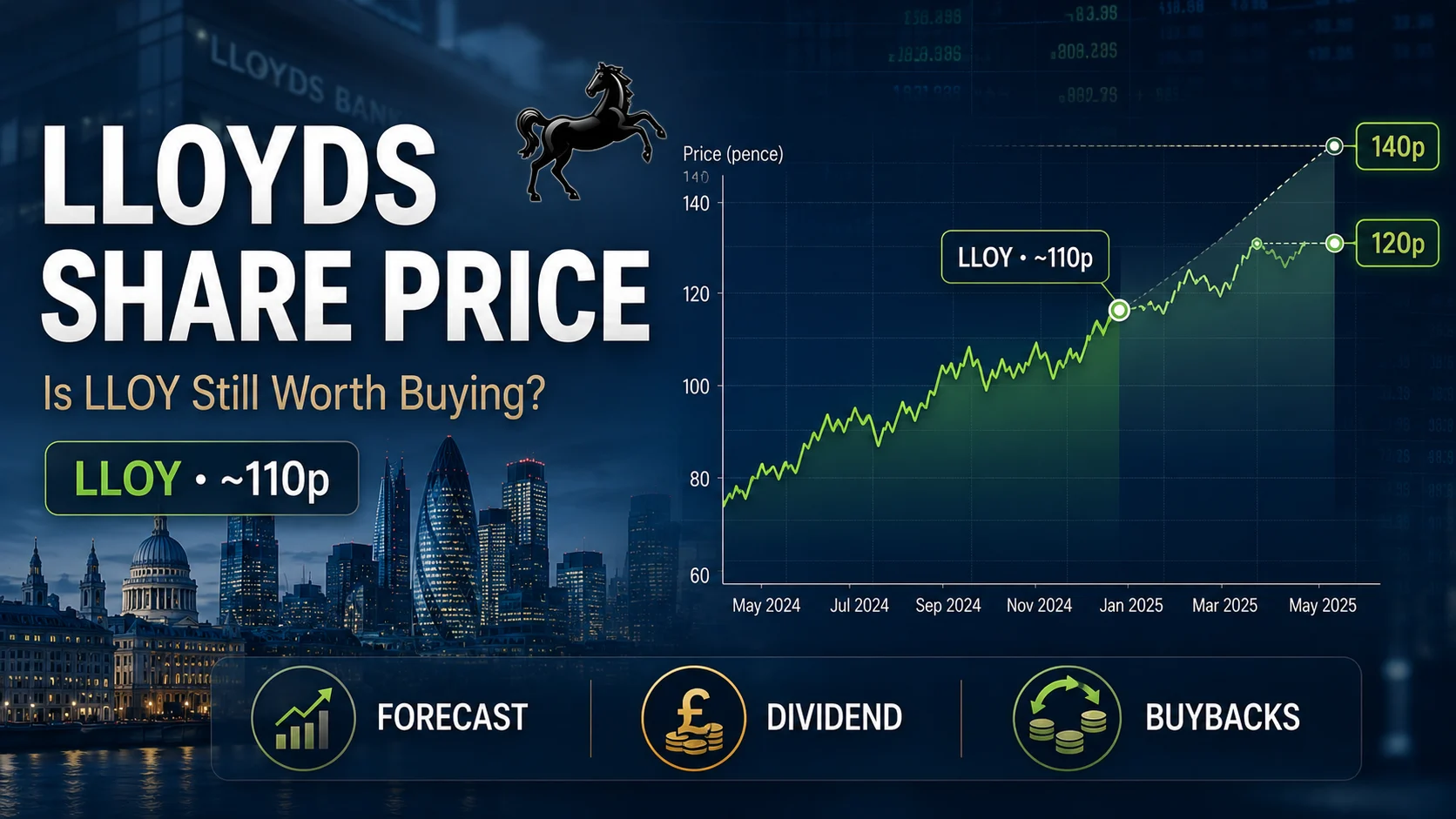
The Lloyds share price has had a strong run, but the big question now is whether there is still enough upside for investors buying at current levels.
Lloyds Banking Group has benefited from stronger profits, higher shareholder returns and a large share buyback programme. At the same time, mortgage competition, interest rates, motor finance costs and the possibility of a higher tax burden for UK banks could limit future gains.
I think Lloyds is now more interesting as a combination of share-price growth and shareholder income than as a simple recovery stock. Here is how I would assess the shares from the current level.
Quick Answer
The Lloyds share price is trading around the 110p area, close to its recent highs. Analyst targets generally point to further upside, although the size of that upside varies between forecasts. Strong earnings, dividends and buybacks support the investment case, while interest rates, mortgage margins, credit losses and regulatory costs remain key risks.
Lloyds at a Glance

Lloyds Banking Group is one of the UK’s largest banking groups. Its business includes retail banking, commercial banking, insurance, pensions and investment services.
For shareholders, the main attraction is fairly simple: Lloyds can return cash through dividends and share buybacks while using its large UK customer base to generate earnings.
The current share price also matters because a good company can still become a less attractive investment if investors pay too much for it.
Here is the basic picture I would keep in mind:
| Factor | Current picture |
| Share | Lloyds Banking Group |
| Ticker | LLOY |
| Market | London Stock Exchange |
| Recent share price | Around 110p |
| Recent 52-week high | Around 118p |
| Analyst outlook | Generally positive, but targets vary |
| Dividend | Growing |
| Buybacks | Active |
| Main earnings driver | Net interest income and other banking income |
| Main risks | Rates, mortgage margins, credit losses and regulatory costs |
The exact Lloyds share price changes throughout every trading session, so I would treat these figures as a snapshot rather than a fixed valuation.
What Has Happened to the Lloyds Share Price?
Lloyds shares have come a long way from their recent lows. The stock reached about 118p during August before pulling back, leaving it several percent below that 52-week high at points in late August.
That tells me something important about the current investment case.
The market has already recognised a large part of the improvement in Lloyds’ financial position. Investors are no longer simply betting on a recovery from weak banking conditions. They are now looking for continued earnings growth, strong capital returns and evidence that Lloyds can maintain its profitability.
That changes the question from:
“Can Lloyds recover?”
to:
“Can Lloyds keep growing enough to justify a higher share price?”
I think that is the more useful question for anyone looking at LLOY today.
The 52-Week Range Matters
A share price near its 52-week high does not automatically mean a stock is expensive.
It simply means expectations are higher than they were previously.
If earnings continue to improve, Lloyds could move beyond its previous high. If earnings growth slows or investors become worried about UK banks, the stock could also fall sharply from these levels.
This is why I would look at the underlying numbers rather than using the 52-week high as a buy or sell signal.
What Is Driving Lloyds Shares Right Now?

Several factors are influencing the Lloyds share price at the same time.
The most important are earnings, interest rates, net interest income, mortgage pricing, the UK economy and shareholder returns.
1. Lloyds Is Producing Stronger Earnings
Lloyds reported a statutory profit after tax of £3.1 billion for the first half of 2026, up 23% year over year. Return on tangible equity reached 17.1%, while underlying net interest income rose 9% to £7.3 billion.
These numbers give investors a stronger base for valuing the company.
I would pay particular attention to return on tangible equity because it shows how effectively the bank is generating returns from its capital base.
A rising share price backed by stronger profitability is much easier to justify than a share price rise driven mainly by investor sentiment.
2. Interest Rates Still Matter
Banks make money partly from the difference between the interest they receive on loans and the interest they pay on deposits and other funding.
This makes interest rates extremely important for Lloyds.
When rates are favourable, net interest income can benefit. But the relationship is not as simple as “higher rates are always good for banks.”
Lloyds also has to compete for mortgage customers and deposits. If mortgage rates fall or banks compete aggressively for borrowers, lending margins can come under pressure.
That is one reason I would watch net interest margin alongside headline earnings.
3. Net Interest Income Remains a Major Driver
Lloyds’ underlying net interest income reached £7.3 billion in the first half of 2026, supported by a higher banking net interest margin and structural hedge income.
A structural hedge helps protect part of the bank’s earnings from changes in interest rates. This can make income more stable than simply looking at the current Bank of England rate.
However, I would not assume that today’s margin will continue forever.
Mortgage pricing, deposits, competition and future rate movements can all change the picture.
4. The UK Mortgage Market Could Become More Difficult
Lloyds has a large exposure to UK households and mortgages.
That gives the bank a huge customer base, but it also means mortgage competition matters.
If lenders compete heavily on mortgage rates, the margin on new loans can shrink. This could put pressure on future net interest income even if the number of customers and loans continues to grow.
For me, this is one of the less obvious factors behind the Lloyds share price.
A bank can report strong headline profits while investors become concerned about the profitability of new lending.
5. The UK Economy Could Help or Hurt
Lloyds is closely tied to the UK economy.
A healthy economy can support mortgage demand, business lending, consumer spending and loan quality. A weaker economy can have the opposite effect.
If unemployment rises or household finances become strained, banks can face higher credit losses.
That means I would watch UK economic conditions alongside Lloyds’ own results rather than analysing the company in isolation.
Lloyds Financial Performance
The latest results provide several reasons for investors to remain interested.
During the first half of 2026, Lloyds reported:
- £9.7 billion of net income
- £3.1 billion statutory profit after tax
- 17.1% return on tangible equity
- £7.3 billion underlying net interest income
- 2% loan growth
- 1% deposit growth
- £1.9 billion of total capital return, including dividends and buybacks
The bank also raised its 2026 expectations, including underlying net interest income above £14.9 billion and return on tangible equity above 16%.
I see the combination of profitability and capital generation as one of the strongest parts of the current Lloyds investment case.
Capital Position
A bank needs enough capital to absorb losses while continuing to operate and return money to shareholders.
Lloyds is targeting a CET1 ratio of about 13% for 2026. Its strong capital position has also allowed the group to return more cash to shareholders through dividends and buybacks.
For investors, that matters because buybacks can reduce the number of shares in circulation.
If earnings remain strong while the share count falls, earnings per share can receive an additional boost.
Lloyds Share Price Forecast

Analyst forecasts provide a useful reference point, but I would not treat them as a promise of where the Lloyds share price will trade.
Recent analyst estimates have generally placed the 12-month target above the current share price. One set of estimates put the average target around 122p, while another survey showed a median target of 125p, with a high estimate of 140p and a low estimate of 93p.
That wide range tells me that analysts agree less about the exact value of Lloyds than they do about the general direction.
The difference between a 122p and 125p target is relatively small. The much wider high and low estimates show how sensitive the valuation is to assumptions about earnings, interest rates, economic conditions and future returns.
What Could Push LLOY Higher?
I see three broad conditions that could support a higher Lloyds share price:
- Earnings continue to beat expectations.
- Dividend growth and buybacks remain strong.
- Investors become more confident that Lloyds can maintain high returns on equity.
If those three things happen together, the current share price could look less demanding.
What Could Keep the Share Price Near 110p?
The stock could struggle to make further progress if earnings growth slows while valuation expectations remain high.
Mortgage competition is one possible reason.
A weaker UK economy, higher credit losses or pressure on banking margins could also make investors less willing to pay a premium for Lloyds shares.
This is why I would not base a Lloyds share price forecast on one target alone.
Could Lloyds Shares Reach 120p?
Yes, 120p is a realistic level to discuss because it sits relatively close to the current trading range and is around the area covered by several analyst forecasts.
But reaching 120p would still require the market to maintain confidence in Lloyds’ earnings and shareholder returns.
From around 110p, a move to 120p would represent roughly 9% capital growth.
That is meaningful, but investors should also consider dividends because the total return can be higher than the share-price gain alone.
Could Lloyds Shares Reach 140p?
A move to 140p would be much more demanding.
At 140p, Lloyds would need either stronger earnings growth, a higher valuation multiple, or both.
Some analyst forecasts have placed the upper target around 140p.
I would therefore treat 140p as a bullish scenario rather than my default expectation.
The important point is that Lloyds does not need to reach 140p for shareholders to receive a reasonable return. A combination of moderate capital growth, dividends and buybacks could still produce an attractive total return.
Lloyds Dividend: An Important Part of the Investment Case
The dividend is one of the reasons Lloyds shares remain popular with income-focused investors.
The bank increased its 2026 interim dividend to 1.58p per share, a 30% increase from the previous year. The payment is scheduled for 15 September 2026 for shareholders who met the relevant eligibility dates.
Lloyds also announced a £1 billion share buyback alongside its half-year results. This was in addition to the £1.75 billion buyback announced with the full-year results.
Dividend or Buyback?
Both can benefit shareholders, but they work differently.
A dividend puts cash directly into the hands of eligible shareholders.
A buyback reduces the number of shares outstanding when the company purchases and cancels its own shares.
I like looking at both together because focusing only on the dividend can give an incomplete picture of Lloyds’ capital-return policy.
Is Lloyds Cheap or Expensive?
This is where I think investors need to be more careful.
Lloyds shares may still look reasonable compared with the earnings and returns the bank is producing, but the stock is no longer trading at the depressed levels seen during weaker periods.
The share price has already reflected a large amount of improved investor confidence.
Price-to-Earnings Ratio
The P/E ratio is one simple way to judge how much investors are paying for each pound of earnings.
A low P/E can suggest a stock is cheap, but it does not automatically make it a bargain.
For a bank such as Lloyds, I would also look at return on tangible equity, book value, capital generation, dividend capacity and the quality of earnings.
Return on Tangible Equity
Lloyds’ 17.1% return on tangible equity in the first half of 2026 is an important figure.
If the bank can sustain high returns while maintaining a healthy capital position, the market may be willing to place a higher valuation on the shares.
That is one of the reasons I would watch ROTE closely in future results.
Three Things That Could Help LLOY Rise
Stronger Earnings Growth
If Lloyds continues to increase income while controlling costs, investors may raise their expectations for future earnings.
That could support both the share price and the dividend.
More Share Buybacks
Additional buybacks could reduce the number of shares in circulation.
If earnings remain stable or increase, that can improve earnings per share and potentially support the valuation.
Better Investor Confidence
Bank shares can remain cheap for long periods when investors are worried about the economy.
If investors become more confident about UK growth, credit quality and banking profitability, Lloyds could benefit from a higher valuation.
Three Risks to the Lloyds Share Price
1. Falling Banking Margins
Mortgage and deposit competition could reduce the margin Lloyds earns on new business.
This is particularly important because strong current earnings do not guarantee equally strong earnings several years from now.
2. Motor Finance Costs
Motor finance compensation remains a significant issue for UK banks.
The final cost and timing of these liabilities can affect profits, capital and investor sentiment. I would therefore continue watching developments in this area rather than assuming the issue is fully behind Lloyds.
3. UK Bank Tax and Regulation
The UK banking sector is also facing political discussion around taxation.
Recent reports have highlighted the possibility of a new windfall tax on banks. If such a measure were introduced, it could affect profitability and potentially reduce the amount available for shareholder returns.
I would not treat a possible tax change as a certainty, but it is a risk worth keeping in the valuation.
What I Think About Lloyds Shares
I think Lloyds is in a much stronger position than it was when the shares were trading at much lower levels.
The combination of rising profits, a strong return on tangible equity, dividend growth and large buybacks gives investors several reasons to remain interested.
However, I would not describe Lloyds as an obvious bargain simply because the shares still trade below some analyst targets.
The market already expects a lot from the company.
For me, the key question is whether Lloyds can keep producing strong returns after accounting for mortgage competition, changing interest rates, credit costs and regulatory expenses.
If it can, the current Lloyds share price may still have room to move higher.
If earnings growth slows, the valuation could become harder to justify.
Lloyds Share Price Outlook for the Next 12 Months
My base case would be for a more measured return than the very strong gains Lloyds has already delivered.
The shares could move above 120p if earnings remain strong and investors continue to support the bank’s capital-return strategy.
A move towards 125p would require a similar combination of healthy earnings, dividend growth and positive sentiment.
The 140p area looks more like a bullish case to me. It would probably require stronger-than-expected earnings or a meaningful improvement in how the market values Lloyds.
There is also a downside case.
If UK economic conditions weaken, credit losses increase, mortgage margins shrink or regulatory costs rise, Lloyds could fall back below its recent trading range.
That is why I would look at the share price forecast as a range of possible outcomes rather than a single number.
What I Would Watch Before Buying Lloyds
If I were assessing LLOY for a new investment, these are the figures I would monitor most closely:
- Net interest income
- Net interest margin
- Return on tangible equity
- CET1 capital ratio
- Loan growth
- Deposit growth
- Credit impairment charges
- Dividend growth
- Share buybacks
- Mortgage pricing
- Motor finance liabilities
- UK interest rates
- Future bank taxation
I would also compare the current Lloyds valuation with other major UK banks rather than looking at LLOY on its own.
That gives me a better idea of whether Lloyds is genuinely cheap or simply trading in line with the wider banking sector.
Final Verdict
The Lloyds share price has already benefited from stronger earnings and improving investor confidence, so I would not approach the stock in the same way as a deeply undervalued recovery play.
The investment case now rests on continued profitability.
If Lloyds can maintain strong returns, grow its dividend, continue buybacks and manage credit and regulatory risks, I think the shares could still deliver further gains.
My view is therefore moderately positive, but I would keep expectations realistic. The most useful way to judge Lloyds from here is to track earnings, valuation and shareholder returns together rather than relying on a single share-price target.
For anyone considering LLOY, the current price is only the starting point. What matters more is whether the company’s future earnings justify paying today’s price.
Frequently Asked Questions
What is the Lloyds share price?
The Lloyds share price has recently traded around the 110p area, although the live price changes throughout the London trading session. The stock reached roughly 118p during August 2026.
What is the Lloyds share price forecast?
Recent analyst forecasts generally place the 12-month target above the current share price, with estimates varying considerably. Some recent estimates have centred around 122p to 125p, while bullish targets have reached 140p.
Does Lloyds pay a dividend?
Yes. Lloyds increased its 2026 interim dividend to 1.58p per share, up 30% from the previous year.
Is Lloyds a good share to buy?
Lloyds has a strong case based on earnings, capital generation, dividends and buybacks. However, whether it is attractive at the current price depends on your investment timeframe, risk tolerance and expectations for future earnings.
Could Lloyds reach 120p?
A move to 120p is plausible if earnings remain strong and investor confidence continues. It would represent a relatively modest increase from the recent 110p area.
Could Lloyds reach 140p?
It is possible, and some analyst targets have reached 140p. However, I would treat 140p as a bullish scenario rather than assume it will happen.
Is Lloyds a good dividend stock?
Lloyds can appeal to income investors because it pays dividends and has increased shareholder distributions. Investors should still consider dividend sustainability, earnings, capital requirements and future banking conditions rather than focusing only on the yield.
