
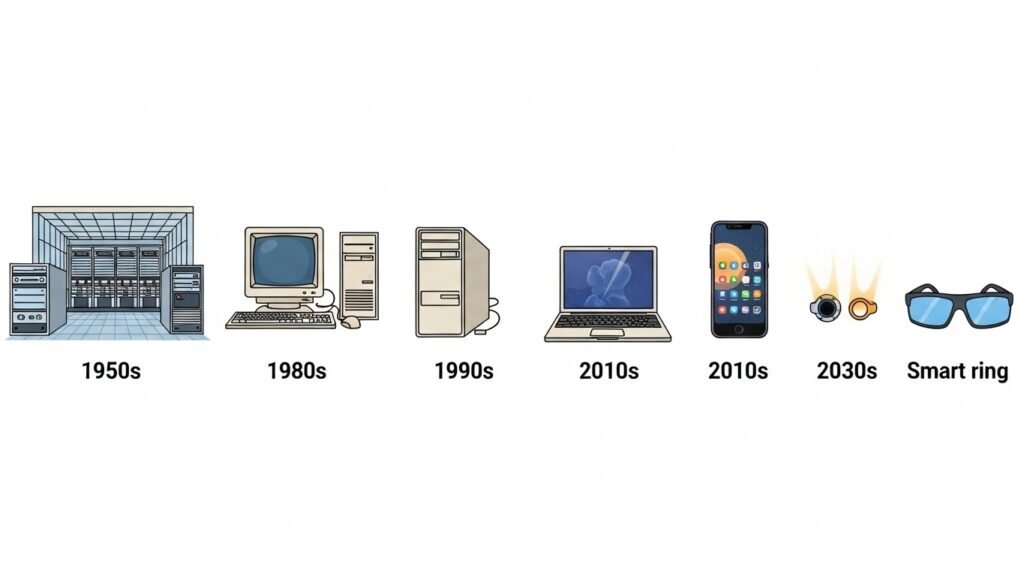
The tech world is buzzing with a big new secret. Many tech giants envision future beyond smartphones as they pour billions into new gadgets. We have used the same glass rectangles for years now. Innovation has hit a wall with only tiny changes to cameras each year. This shift is not just about a new device. It is a total rethink of how we live with tech. We are moving toward a world where screens might disappear forever.
The Shift to a Post-Smartphone Era
The story of computers always follows a path toward getting closer to us. We started with huge rooms full of machines in the fifties. Then we moved to desktops and laptops that fit on our laps. Smartphones were the last step before tech actually touches our skin. Now we are entering the final stage of this long journey.
The smartphone era is not dying in one day. It is slowly changing into something much more exciting and deep. Usage is expected to drop off significantly by the late twenties. Tech giants envision future beyond smartphones by creating ambient intelligence that knows what you need. Fortune 500 companies are already using these tools to make more money. This new era will make our current phones look like old toys.
Key drivers of this shift include:
- Market Saturation. Most people already own a phone and stop buying new ones often.
- Technological Miniaturization. Sensors are now small enough to fit into rings or glasses.
- The Quest for Integration. People want to stop looking down at screens all day long.
- AI as the New Interface. Talking to an AI agent is faster than typing on a screen.
- Economic Incentives. The new market for these gadgets could reach three trillion dollars.
Disruption Timeline: From Mobile to Ambient
The change will happen in waves over the next ten years. Between 2025 and 2026, we will see the first cheap AR glasses hit the stores. Professionals will start using them at work to see data while they move. By 2028, mass market adoption will begin for most regular people. Ambient AI will likely be everywhere in developed countries by then.
By the year 2030, smartphones will start to feel like relics from the past. Over 200 million people might switch to these new ways of computing. We will look back and wonder why we ever carried bricks in our pockets. The world will become a digital environment that responds to our presence. This is the bold future that tech giants envision for all of us.
Spatial Computing and Extended Reality (XR)
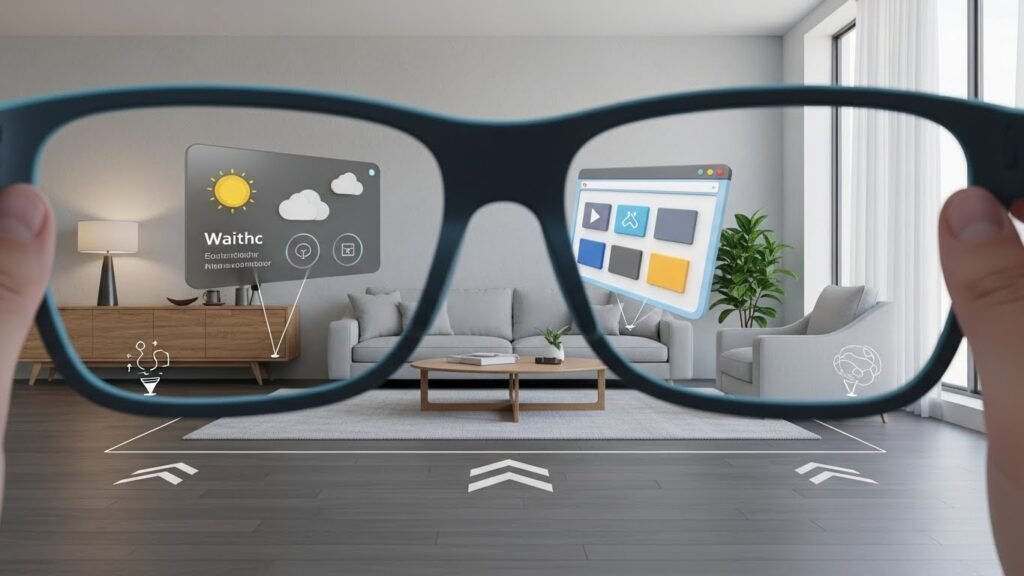
Spatial computing is a fancy way of saying digital stuff stays in the real world. It uses AR glasses and mixed reality to put icons in the air. You can keep your head up and stay present with your friends. This ends the era of everyone staring down at their laps in silence. It is the most natural way for humans to interact with data.
Imagine your computer screen floating right in front of your desk without a monitor. You can resize it with a pinch of your fingers in the air. Tech giants envision future beyond smartphones by making every surface a potential screen. Your kitchen table could show a recipe right on the wood. This makes life feel like a sci-fi movie come to life.
Apple’s Spatial Computing Revolution
Apple is not calling their new gear a headset or a phone. They call it spatial computing to show it is a big change. The Vision Pro is their first big step into this new world. Even though it costs a lot, it shows where they are going. They spent over eight billion dollars on research to get this right.
- Vision Pro & Beyond. This device blends the digital world with the physical room around you.
- Ecosystem Leverage. It works perfectly with your Mac, Watch, and existing iPhone apps.
- Roadmap. Apple is working on lighter glasses that look like normal eyewear.
- Augmented Purchasing. You can see how new furniture looks in your house before buying it.
Meta’s Vision for AR and AI
Meta has bet their whole future on the metaverse and smart glasses. They have spent more than fifty billion dollars on their Reality Labs team. Their goal is to make glasses so good you never want to take them off. The Ray-Ban Meta glasses were a surprise hit with many users last year. They prove that people are ready for tech on their faces.
- Hypernova & Ray-Ban Meta. These glasses can record video and talk to AI agents.
- Holographic Displays. Future versions will show full 3D images in your field of view.
- Social Infrastructure. Meta wants to build the next place where we all hang out online.
- Live AI. The glasses can hear what you hear and help you in real time.
Google’s AI-Integrated AR Ecosystem
Google wants to do for AR what they did for smartphones with Android. They are building an open system that any company can use for glasses. They are working with Samsung and Qualcomm to make this a reality soon. Their R&D spending in this area is over five billion dollars. They want to be the brain behind every pair of smart glasses.
- Project Astra. This AI can look through your glasses and tell you what it sees.
- Android XR. A special version of Android made specifically for heads-up displays.
- Real-Time Translation. Imagine seeing subtitles in the air when someone speaks another language.
- Navigation. Arrows can appear on the actual sidewalk to show you where to walk.
AI Agents and the Ambient Intelligence Revolution
Ambient intelligence is tech that is always there but often invisible. It lives in the walls, the lights, and even your clothes. Tech giants envision future beyond smartphones where you do not need to ask for help. The system learns your habits and does things for you automatically. It is like having a digital butler that lives in your home.
Imagine walking into a room and the music and lights change to your mood. You do not have to touch a single button or open an app. The house knows it is you because of your wearable AI or ring. This is the dream of pervasive computing that is finally coming true. It reduces the digital fatigue of managing too many devices.
OpenAI’s Model: Embedding AI Everywhere
OpenAI is moving fast to put their smart models into physical things. They want their AI to be the ghost in the machine for everything. They are spending billions to make sure their AI can act on your behalf. This is a move toward human-computer symbiosis where we work as one. It is a big shift for how we handle daily chores.
- Ambient Systems. AI that stays in the background and listens for when it is needed.
- Robotics Integration. They are working with Figure AI to give robots smart brains.
- Natural Intent. You just speak or think a goal, and the AI agent does the work.
- Zero Learning Curve. You do not need to learn how to use it; it learns you.
Microsoft’s Holographic and Mixed Reality Push
Microsoft is focusing on helping people get work done in new ways. Their HoloLens has been used by doctors and engineers for years now. They are moving toward the smart office where every surface is interactive. Their strategy uses the cloud to power these heavy digital tasks. This allows for complex work to happen on light devices.
- Industrial AR. Workers can see repair manuals overlaid on a real engine.
- Virtual Meetings. Collaborating with 3D avatars of coworkers from around the world.
- Azure Synergy. Using big data and cloud processing to power mobile AI.
- Holographic Desktops. Replacing bulky monitors with virtual screens in your field of view.
Wearables and Sensor-Rich Ecosystems
Wearables are the bridge between our phones and our bodies. We already have watches and rings that track our sleep and heart. Soon, these will become our primary way to talk to computers. Tech giants envision future beyond smartphones where your jewelry is your computer. This makes tech more personal and less of a distraction.
Smart rings and fitness trackers are becoming incredibly powerful tools. They can now measure things that used to require a hospital visit. This is part of the shift toward a sensor-embedded world. Our clothes might even have tech woven into the fabric itself. It is a future where you never have to remember to bring your phone.
- Medical-Grade Accuracy. Wearables that can spot a health problem before you feel it.
- Gesture-Based Control. Moving your fingers in the air to scroll through a menu.
- Biometric Signals. Tech that knows you are stressed and suggests a break.
- Digital Twins. A digital version of your body that helps doctors treat you.
- Smart Hubs. Your watch or ring might soon be the brain for your glasses.
The Ultimate Frontier: Brain-Computer Interfaces (BCI)
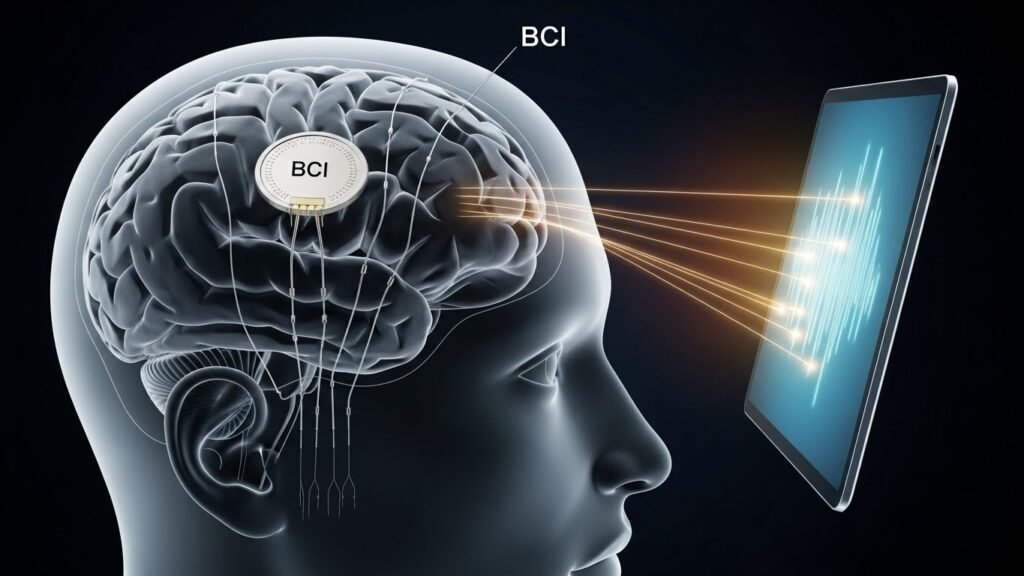
Brain-computer interfaces are the most extreme version of this new future. They allow your brain to talk directly to a digital device. This removes the need for talking, typing, or even moving. It is like having a digital layer added to your own mind. While it sounds scary, it has the power to change lives.
Many experts say we are already cyborgs because of our phones. We use them for memory, math, and talking to people far away. A BCI just puts that power directly inside our heads for speed. It is the logical end to the path of smaller and smaller tech. This is the final step in the tech giants’ vision for us.
Neuralink’s Approach: Direct Brain-to-Digital Links
Elon Musk’s Neuralink is the most famous company in this space. They want to help people with paralysis control computers again. Their first human trials have already shown amazing results so far. The market for this tech is growing at a very fast pace. It could eventually be something that healthy people use too.
- The N1 Implant. A tiny chip with 1024 electrodes that reads brain signals.
- Thought-Controlled Computing. Surfing the web or playing games just by thinking.
- Cognitive Augmentation. Making our brains faster or better at remembering things.
- Neural Interfaces. Connecting our nervous system to the global internet.
Breakthrough Technologies Powering the Transition
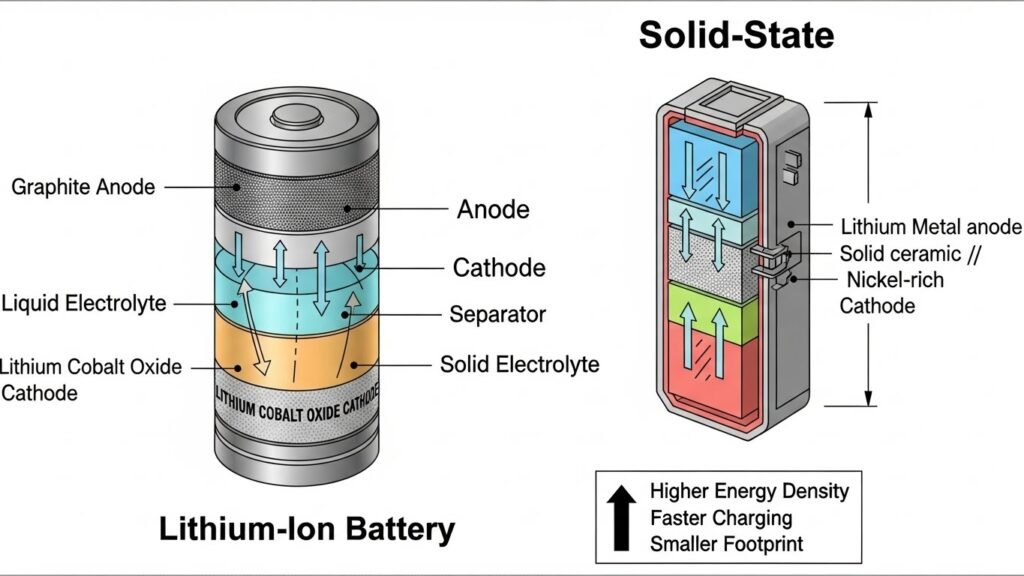
None of this would be possible without some big science breakthroughs. We need better screens, faster chips, and way better batteries. Tech giants envision future beyond smartphones by solving these hard problems. These new parts will make devices small enough to be invisible. It is a massive engineering challenge for every single company.
Technology Comparison Table
| Technology | Purpose | Current Status |
| AR Glasses | Digital Overlay | Early Consumer |
| AI Agents | Proactive Help | Growing Rapidly |
| BCI Implants | Mind Control | Clinical Trials |
| Solid-State Batteries | Long Life | In Development |
Micro-LED Displays. These tiny screens are bright enough for sunny days.- Solid-State Batteries. These last much longer and charge in just minutes.
- Edge Computing. Processing data on the device instead of the cloud.
- Wireless Power. Charging your gadgets through the air as you walk.
- Haptic Feedback. Feeling digital objects as if they were actually real.
Cybersecurity Measures for a Post-Smartphone World
As tech giants envision a future beyond smartphones, the shift toward a world filled with sensors, brain interfaces, and ambient intelligence creates a massive new surface for digital threats. With over 70% of users expressing deep privacy concerns, the success of this transition depends on building a robust, transparent, and user-controlled security infrastructure.
Advanced Identity and Biometric Protection
In a screenless world, traditional passwords become obsolete, requiring security to move closer to the human body.
- Neural and Biometric Encryption: Protecting the privacy of a user’s thoughts is a top priority, requiring encryption that secures data directly from Brain-Computer Interfaces (BCIs).
- Continuous Authentication: Wearables like smart rings or watches will monitor unique biometric signals to ensure the user is who they say they are without needing a login.
- Digital Twin Security: As we create digital versions of our bodies for medical use, these “Digital Twins” must be shielded from unauthorized access to prevent sensitive health data leaks.
Securing Ambient and Invisible Computing
Ambient intelligence lives in the walls and environments around us, making the physical world a potential target for hackers.
- Edge Processing for Privacy: Tech giants are focusing on “Edge Computing,” where data is processed on the local device rather than sent to the cloud, keeping sensitive environmental data private.
- Transparent Data Governance: To address concerns that tech is “always watching,” systems must offer clear, user-defined zones where sensors are disabled or data is immediately deleted.
- Zero-Trust Environments: Smart homes and offices will need to operate on a zero-trust model, where every sensor and wearable must constantly verify its identity before interacting with the broader ecosystem.
Safeguarding AI Agents and Autonomous Interaction
When AI agents manage our finances, shopping, and schedules, a security breach could have immediate physical and financial consequences.
- Intent Verification: AI agents will require “Human-in-the-Loop” confirmation for high-risk tasks, ensuring that the AI is acting on a genuine human goal and not a malicious prompt.
- Sandboxed AI Environments: To prevent “Ethical AI” failures or bad decisions, autonomous agents must operate within restricted digital sandboxes that prevent them from accessing critical systems without explicit consent.
- Haptic Security Feedback: Future devices may use haptic feedback—physical sensations—to alert a user if their digital identity is being accessed or if a nearby sensor is recording them.
Protecting Infrastructure and Connectivity
The high bandwidth and low latency required for spatial computing make the networks themselves a critical point of failure.
- Ultra-Low Latency Encryption: As 5G and 6G networks render immersive layers in real time, security protocols must be fast enough to encrypt data without causing lag or “eye strain” for the user.
- Blockchain-Based Data Integrity: Using decentralized ledgers can help verify the integrity of the information seen through AR glasses, ensuring that digital overlays have not been tampered with by bad actors.
Social Implications of a Post-Smartphone World
The transition from handheld devices to a world of ambient and integrated technology is not just a technical shift; it is a profound social evolution. As tech giants envision a future beyond smartphones, our physical environments and social interactions will be redefined by constant connectivity and invisible computing.
Redefining Human Interaction and Presence
The shift to spatial computing and AR glasses aims to solve the problem of “digital isolation” caused by current mobile devices.
- Restoring Eye Contact: By moving digital interfaces from our laps to our eye line, users can stay present with friends and family while accessing information.
- Digital Inclusion and Accessibility: For individuals with disabilities, brain-computer interfaces (BCIs) offer the potential to restore communication and physical control, fundamentally changing their social participation.
- Holographic Socializing: Communication will move beyond 2D video calls to life-sized hologram interactions, making long-distance connections feel physically real.
The Challenge of Social Acceptance and Friction
Despite the benefits, moving technology to the face and body introduces new cultural hurdles.
- The “Glasshole” Effect: Tech giants must overcome the social stigma of wearing cameras and sensors in public spaces to avoid awkwardness or perceived surveillance.
- Stylish vs. Bulky Design: Widespread adoption depends on devices like the Ray-Ban Meta glasses being comfortable and looking like normal eyewear rather than heavy headsets.
- Digital Fatigue and Intrusion: While ambient computing aims to reduce the “device management” burden, the feeling of technology being “always there” could lead to new forms of digital burnout.
Ethical Considerations and Digital Autonomy
As technology merges with human biology and environments, the boundaries of personal identity and consent become blurred.
- Autonomy in the Age of AI Agents: When AI agents manage our daily chores and make decisions on our behalf, we must ensure users maintain ultimate control over their digital lives.
- The Cognitive Divide: There is a risk of a new “digital divide” where only the wealthy can afford cognitive augmentation or advanced BCIs, leading to social inequality.
- The Privacy of Thoughts: The most extreme shift—BCIs—introduces scary questions about the sanctity of private thought and who owns the data generated by our nervous systems.
Impact on Physical Spaces and Community
Our homes and cities will change as they become “intelligent zones” that respond to our presence.
- Pervasive Environments: The dream of pervasive computing means our houses and offices will know our moods and habits, potentially reducing the friction of daily life.
- Interactive Public Spaces: Navigation cues and arrows appearing on actual sidewalks could make exploring new cities more intuitive and safe.
- The Hybrid World: Every surface, from a kitchen table to a park bench, becomes a potential screen, turning the entire world into an interactive canvas for creativity and work.
Challenges and Roadblocks to the Vision
This new world brings up some very big and scary questions. Privacy is the biggest worry for almost everyone involved. If tech is always watching and listening, where is our data?. We also need to make sure these devices are comfortable. No one wants a heavy, hot computer on their face.
- Data Privacy. Keeping our thoughts and biometrics safe from hackers.
- Social Acceptance. Making sure people don’t feel awkward wearing cameras.
- Digital Inclusion. Ensuring everyone can afford this new tech, not just the rich.
- Ethical AI. Making sure AI agents don’t make bad decisions for us.
- Health Concerns. Making sure these devices are safe for our eyes and brains.
Impact on Everyday Life
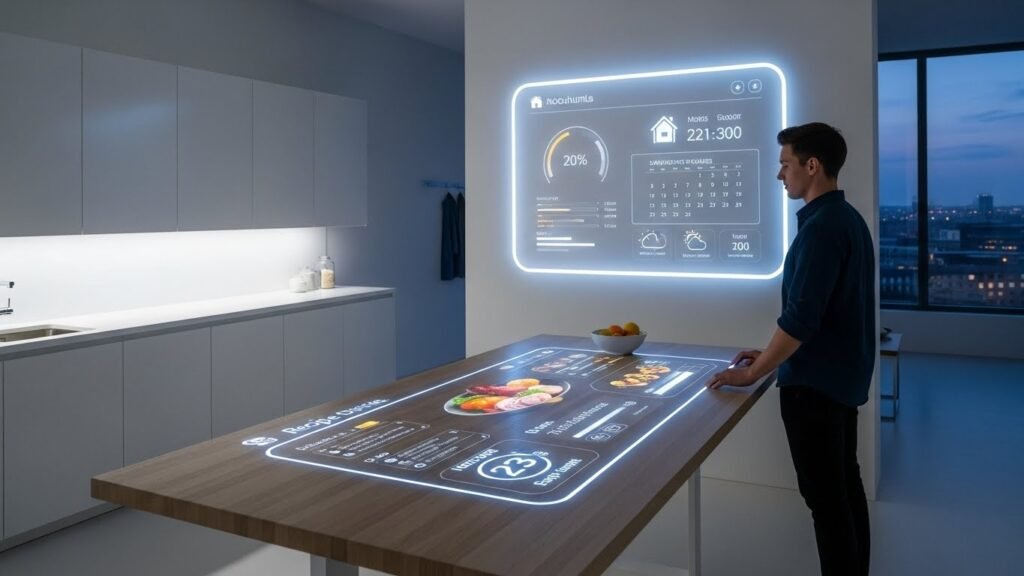
When these tools arrive, our daily routines will change forever. Work will happen in virtual workspaces with holographic coworkers. We will learn by seeing history happen in our living rooms. Communication will feel more like being in the same room. It is a shift toward a more connected and human world.
- Education. Students can take a virtual trip to Mars or Rome.
- Shopping. Seeing a 3D model of clothes on yourself before buying.
- Health. Your ring can alert your doctor if you start getting sick.
- Entertainment. Movies that play out all around you in your real house.
The Environmental Footprint of a Billion-Sensor World
While tech giants envision a future beyond smartphones as a path toward a “cleaner” digital life, the physical reality of building this world is complex. Manufacturing the billions of sensors, wearables, and ambient processors required for this transition carries a significant environmental price tag. However, the same technology also offers the most powerful tools we have ever had to protect the planet.
The Hidden Cost of Manufacturing and Resource Depletion
Every smart ring, AR headset, and ambient sensor begins its life in a mine. The materials required to make these devices are finite and often difficult to extract.
- Extraction of Rare Earth Minerals: Manufacturing the advanced sensors for BCIs and AR glasses requires energy-intensive mining of rare earth metals and precious minerals like cobalt and lithium. This process often leads to habitat destruction and high water consumption.
- Energy-Intensive Production: The complex manufacturing processes for microchips and high-density sensors generate significant carbon emissions. Experts estimate that the energy needed to produce billions of IoT nodes could dwarf the carbon footprint of traditional computing devices.
- Resource Scarcity: As we move toward a trillion-sensor economy, the demand for finite materials could lead to resource depletion, highlighting the urgent need for circular manufacturing and extended product lifespans.
The Growing Crisis of E-Waste and Miniaturization
As devices get smaller and more integrated into our lives, they become harder to recycle. This “hidden e-waste” is one of the fastest-growing environmental challenges.
- Complexity of Recycling: Unlike a bulky laptop, a smart ring or a sensor woven into clothing is incredibly difficult to dismantle. These devices often use non-removable batteries and soldered parts that traditional recycling centers cannot process.
- Toxic Chemicals in the Soil: When tiny sensors are discarded in regular trash, they can leak hazardous substances like lead, mercury, and cadmium into the soil and water systems, harming local ecosystems.
- Planned Obsolescence: The rapid pace of innovation pushes consumers to replace wearables every 1–2 years, creating a massive surge in discarded electronics that currently have a formal recycling rate of less than 23%.
The “Green IoT” Solution: Sensors as Environmental Protectors
Despite the manufacturing costs, many tech giants argue that the net impact of this technology will be positive. By making the “invisible visible,” sensors are actually helping us reach net-zero goals.
- Precision Resource Management: Smart sensors in agriculture can prevent farmers from using too much water or fertilizer, while ambient home sensors can reduce energy waste in vacant rooms by up to 29%.
- Real-Time Pollution Tracking: Wearable and mobile sensors are now being used to crowdsource air quality data, allowing communities to identify pollution hotspots and hold polluters accountable.
- Optimizing the Smart Grid: Intelligent sensors in the power grid facilitate the integration of renewable energy sources, potentially reducing global greenhouse gas emissions by up to 20%.
- Eco-Friendly Manufacturing: The rise of “Green IoT” focuses on using bio-based components, energy-efficient designs, and solar-powered sensors to minimize the lifecycle footprint of the technology itself.
Moving Toward a Circular Digital Economy
To ensure the post-smartphone era is truly sustainable, industries are shifting their strategy toward long-term resource recovery.
- Design for Disassembly: Future wearables are being designed to be easily taken apart, allowing precious metals to be recaptured and reused in new devices.
- Extended Producer Responsibility (EPR): Tech companies are increasingly held accountable for the entire life of a product, creating economic incentives for them to build gadgets that last longer and are easier to recycle.
- Biodegradable Electronics: Scientists are researching synthetic substitutes and bio-based components that could eventually allow sensors to dissolve harmlessly at the end of their life, ending the e-waste crisis forever.
Conclusion: The Cybernetic Evolution
The smartphone has been a great tool for a long time. But tech giants envision future beyond smartphones because we deserve more. We want tech that helps us stay in the real world. We want devices that understand us without being told. The coming years will be the most exciting in tech history.
The goal is to make tech almost invisible and totally natural. We are moving from devices to interconnected ecosystems. This transition will take time, but it is already starting today. Get ready for a world that is smarter and more immersive. The future is closer than you might think right now.
FAQs About the Future Beyond Smartphones
Will smartphones disappear completely in the next decade?
No, they will not vanish overnight but will likely coexist with new technologies until advanced devices like AR glasses become more practical for the general public. As tech giants envision future beyond smartphones, the transition is expected to be a gradual evolution where people slowly rely less on a single handheld device.
What is the estimated market value of post-smartphone technology?
The sector represents a massive $3 trillion economic opportunity as digital capabilities blend naturally into our environment. This shift is fueled by over $150 billion in collective investments from major tech firms into emerging fields like ambient computing and BCI.
How will AR glasses handle the high cost of production?
Currently, prototypes can cost up to $10,000 per unit, which is a major barrier to mass adoption. Tech giants are working with suppliers to develop cost-effective displays and components to make these devices affordable for the average consumer.
What role does 5G and 6G play in this transition?
Spatial computing and AI agents require high bandwidth and ultra-low latency to function smoothly. Robust cloud support and advanced connectivity are essential for rendering immersive digital layers in real time without lag.
How does the “N1 Implant” from Neuralink actually work?
The N1 Implant uses 1024 electrodes to map and interpret brain signals, allowing for 99.2% accuracy in thought-controlled computing. It aims to provide a direct brain-to-digital link, enabling users to control devices without any physical movement.
Are there less invasive alternatives to brain implants?
Yes, companies like Synchron are developing stent-based interfaces that do not require open-brain surgery. These alternatives are part of a $1.8 billion venture capital surge into the BCI market.
What is “Project Astra” in the context of Google’s vision?
Project Astra is an artificial intelligence tool designed for AR glasses that understands the user’s surroundings through voice and gestures. It is a key part of Google’s strategy to create an open, AI-integrated ecosystem.
How will battery life issues be solved for wearable tech?
Tech giants are exploring solid-state batteries that offer triple the density of current batteries. Additionally, wireless power systems and energy harvesting from body heat or ambient sources are being developed to enable perpetual operation.
What is the difference between AR, VR, and XR?
Augmented Reality (AR) overlays digital data on the real world, while Virtual Reality (VR) is fully immersive. Extended Reality (XR) is the umbrella term that combines AR, VR, and mixed reality into one seamless ecosystem.
Will AI agents replace traditional mobile apps?
Yes, the goal is for conversational interfaces to replace complex menus and app stores. Instead of opening an app, users will simply express their intent to an AI agent that manages tasks like shopping or scheduling automatically.
How does ambient computing reduce digital fatigue?
Ambient computing integrates technology into the environment so it disappears into daily routines. This shift reduces the need for constant screen attention, making digital interactions feel less intrusive.
What are the main ethical concerns regarding BCIs?
The use of direct brain interfaces introduces complex questions about user autonomy, data consent, and digital identity. Protecting the privacy of a user’s thoughts is a top priority for ethical AI development.
How will spatial computing affect the education sector?
Spatial computing allows for interactive AR lessons and virtual field trips where digital objects can be manipulated with lifelike precision. This creates more immersive and personalized learning paths for students.
Can smart glasses help with real-time language translation?
Yes, many tech giants are developing smart glasses that use AI to provide real-time translation and navigation cues directly in the user’s field of vision.
What is the projected growth of the BCI market by 2030?
The BCI market is expected to grow from $2.3 billion in 2024 to $24.7 billion by 2030. This rapid acceleration is driven by both medical needs and the desire for cognitive augmentation.
How will “Hypernova” glasses differ from current smart glasses?
Hypernova is Meta’s planned AR glasses featuring holographic displays, expected to launch as early as 2025. These are designed to be more stylish and capable than previous bulky headsets.
Will the shift away from smartphones lead to more data collection?
Yes, a world filled with sensors means a higher volume of biometric and environmental data will be collected. Building safe and transparent systems is essential to address the privacy concerns of over 70% of users.
How are automotive companies participating in this leap?
Cars are becoming intelligent extensions of personal ecosystems, featuring autonomous navigation and AI-powered dashboards that connect with other wearables.
What percentage of users currently feel eye strain from XR devices?
In early trials of high-end spatial computing devices like the Vision Pro, approximately 45% of participants reported experiencing eye strain.
What is the ultimate goal of human-centered technology?
The goal is to create a world where technology enhances human capability and creativity while reducing the friction caused by modern screen dependence.